

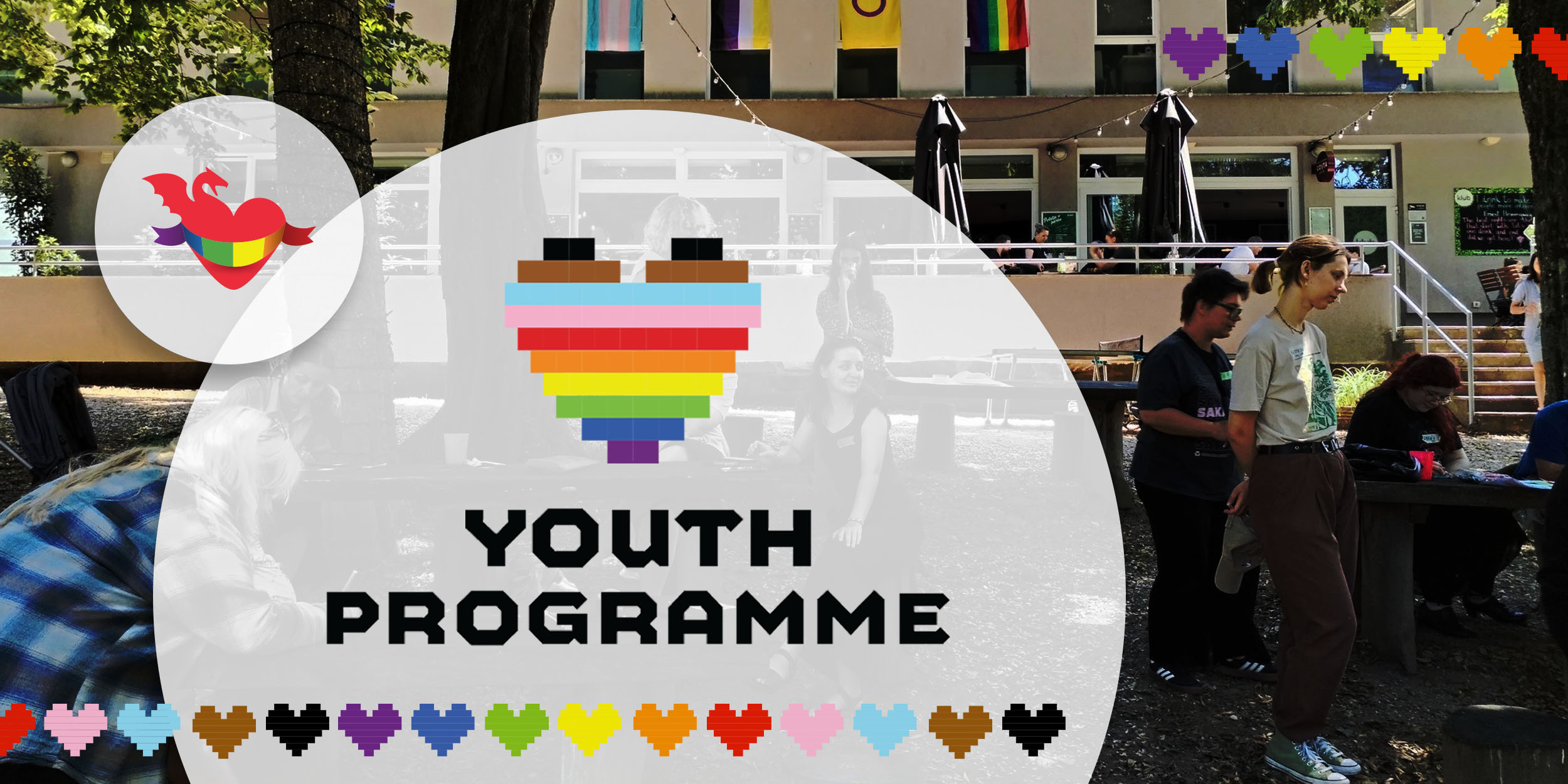
The Youth Programme of Ljubljana Pride is a space for LGBTIQ+ young people where we connect, learn, organise events and work together to create social change. The programme is based on peer education, community building and active citizenship, offering young people opportunities for empowerment, self-expression and participation at the local, national and international levels.
At the heart of the programme are young LGBTIQ+ peer educators and young activists who co-create activities, workshops, interventions and campaigns for other LGBTIQ+ young people. The programme encourages young people to get involved in the planning and implementation of projects and enables them to develop the knowledge, skills, competences and confidence needed to take action in their communities and wider society.
We place a strong emphasis on safe and informal spaces for socialising, such as Kofetkanje and Špajza, where young people can connect without pressure, share experiences and build community. The programme actively addresses current social issues such as precarious work, climate justice, feminism, democracy and the political participation of LGBTIQ+ young people.
The Youth Programme also provides a voice for LGBTIQ+ young people within the youth sector. We advocate for their visibility, rights and needs, and collaborate with other youth and LGBTIQ+ organisations in Slovenia and beyond. Through sustainable approaches and long-term oriented thinking, we are building a programme that is responsive, inclusive and closely connected to the realities of young queer people today.

Projects
Solidarni Balqan
Full project title: BALQAN – Bridges And Links, Queer Activism Now!
Project duration: 1 August 2025 – 31 December 2026
The project is aimed at LGBTIQ+ young people with origins in Western Balkan countries who live in Slovenia, and at strengthening solidarity and connections within the wider LGBTIQ+ community. It stems from the fact that many young people from the Balkans in Slovenia continue to experience discrimination, exclusion and a sense of disconnection – both in wider society and within LGBTIQ+ spaces.
The project creates safe and supportive spaces where young people can connect, share experiences of migration, coming out, living “between cultures”, and strengthen their confidence and sense of belonging. Particular emphasis is placed on overcoming stigma, internalised prejudice and isolation, and on building new community connections.
Through the project, we also promote greater social and political participation of LGBTIQ+ young people from the Balkans – from responding to discrimination and hate speech to participating in elections, protests and other forms of activism. The project connects the Slovenian LGBTIQ+ community with human rights struggles in the Western Balkan region and creates space for learning, exchange and cross-border solidarity.
The main project activities include informal gatherings (Špajze), workshops, peer interventions and international networking with LGBTIQ+ organisations from the region.
The project is implemented within the framework of Erasmus+ Youth Participation Activities and is funded by the European Union.
With youth work against precarity on the job market
Full project title: Z mladinskim delom proti prekarnosti mladih – pilotni projekt – Društvo Parada ponosa
Project duration: 1 June 2024 – 31 December 2026
Project value: EUR 87,060.40
EU co-financing: EUR 34,824.16
Project description, purpose and objectives:
The project With youth work against precarity on the job market addresses one of the key challenges facing young people today – insecure, unstable and often exploitative forms of work. Particular attention is directed to LGBTIQ+ young people, who are often more exposed to precarious work due to discrimination, minority stress and other structural inequalities in the labour market.
Between 2024 and 2026, we are conducting workshops aimed at raising awareness of precarious work, understanding the labour market and empowering young people to enter the world of work in a safer and more informed way. The workshop content includes, among other things:
- identifying precarious forms of employment and the risks they entail;
- developing a basic understanding of workers’ rights and obligations and navigating the Employment Relationships Act (ZDR-1);
- recognising and addressing discriminatory practices in the workplace;
- preparing a CV and preparing for a job interview;
- the basics of self-employment (s. p.), paying social security contributions and meeting tax obligations.
In addition to group activities, in 2025 and 2026 the project also includes individual counselling for young people who need support with job seeking, understanding payslips, registering with the Employment Service of Slovenia or other work-related questions. We particularly aim to reach LGBTIQ+ people facing multiple challenges, such as homelessness, migration status, mental health difficulties or other forms of social exclusion. The project is, however, open to anyone who needs support or information in this area.
Between 2024 and 2026, we aim to involve at least 150 young LGBTIQ+ people in the project.
For individual counselling and additional information about the project, please contact Evan Rodi, deputy coordinator of the pilot project With youth work against precarity on the job market, at evan@ljubljanapride.org.
The project is co-financed by the EU.

Queering the Green, Greening the Queer
Full project title: Greening the Queer and Queering the Green – Sustainable Prides for Climate Justice
Project duration: 1 June 2025 – 31 December 2026
The project addresses the intersection of LGBTIQ+ issues and climate justice, as well as the lack of sustainable practices and political awareness of climate justice within the LGBTIQ+ community. It is based on the understanding that LGBTIQ+ young people, due to social marginalization, are often among those most affected by climate crises, while their voices remain underrepresented in environmental movements.
The project aims to strengthen the connection between queer struggles and the struggle for climate justice as well as to contribute to a more sustainable, politically engaged and solidaristic LGBTIQ+ community. In particular, we aim to empower young LGBTIQ+ people to take active action and advocate in this area, strengthen environmentally sustainable organizing of pride parades, and contribute to stronger connections between the LGBTIQ+ community and the climate movement.
Between 2025 and 2026, we will carry out:
- creative workshops to develop sustainable promotional materials for the Ljubljana Pride Festival;
- digital and in-person community actions;
- training sessions for young people and LGBTIQ+ organisations;
- mobilisation for climate and environmental policy actions;
- dialogue with decision-makers and the development of joint political demands by young people.
Funded by the European Union.

Unavoidably Intertwined
Full project title: Unavoidably Intertwined: Where Climate Justice and LGBTIQ+ Rights Meet
Project duration: 1 October 2025 – 30 September 2026
The project responds to the shrinking democratic space, growing hostility in the public sphere and the systematic exclusion of young people – particularly LGBTIQ+ young people, young women and other marginalized groups – from political processes. Although these groups are often among those most affected by climate crises, environmental degradation and social inequalities, their voices are largely absent from discussions on climate justice and political decision-making.
The project is based on the understanding that the struggle for human rights and the struggle for climate justice are inextricably linked, and that it is essential to strengthen the visibility, political participation and narrative power of marginalized young people at a time when feminist, queer and environmental messages are increasingly being pushed to the margins or targeted by attacks.
The project aims to strengthen young people’s voices, reclaim public space through positive and inclusive narratives, and contribute to more democratic, just and climate-responsive policies.
Between the end of 2025 and 2026, through creative writing workshops with young LGBTIQ+ people and other marginalized young people, we will develop political messages, slogans and statements to be used in a public and digital campaign. The project also includes directly addressing political parties and candidates, as well as collecting young people’s stories through an online survey on the impacts of the climate crisis on their lives.
During the Ljubljana Pride Festival, we will implement a visible poster campaign in public space and organise workshops with international LGBTIQ+ activists, followed in the summer by a digital social media campaign. The project will conclude with a conference where we will present the achievements and lessons learned and address the needs and demands of LGBTIQ+ young people at the city level.
Funded by the European Union.


Democracy Lab
Project duration: 1 December 2025 – 30 November 2026
The project aims to strengthen the democratic participation of LGBTIQ+ young people and foster closer connections between the LGBTIQ+ movement and broader pro-democracy initiatives in Slovenia and the region. It responds to growing pressures on democracy and low levels of political participation among young people, particularly those from marginalized groups.
The project focuses on mobilizing LGBTIQ+ young people and allies for active participation in democratic processes, such as elections, protests and public campaigns. Particular emphasis will be placed on the 2026 parliamentary elections, which we see as a crucial moment for the future of human rights and democratic freedoms in Slovenia.
Through the project, we will address the real risks of restrictions on the right to protest, reproductive rights and the public visibility of the LGBTIQ+ community, including the continued existence of Pride.
Funded by ILGA-Europe.

Programme made possible by:


Co-funded by the European Union. Views and opinions expressed are however those of the author(s) only and do not necessarily reflect those of the European Union or the European Education and Culture Executive Agency (EACEA). Neither the European Union nor EACEA can be held responsible for them.