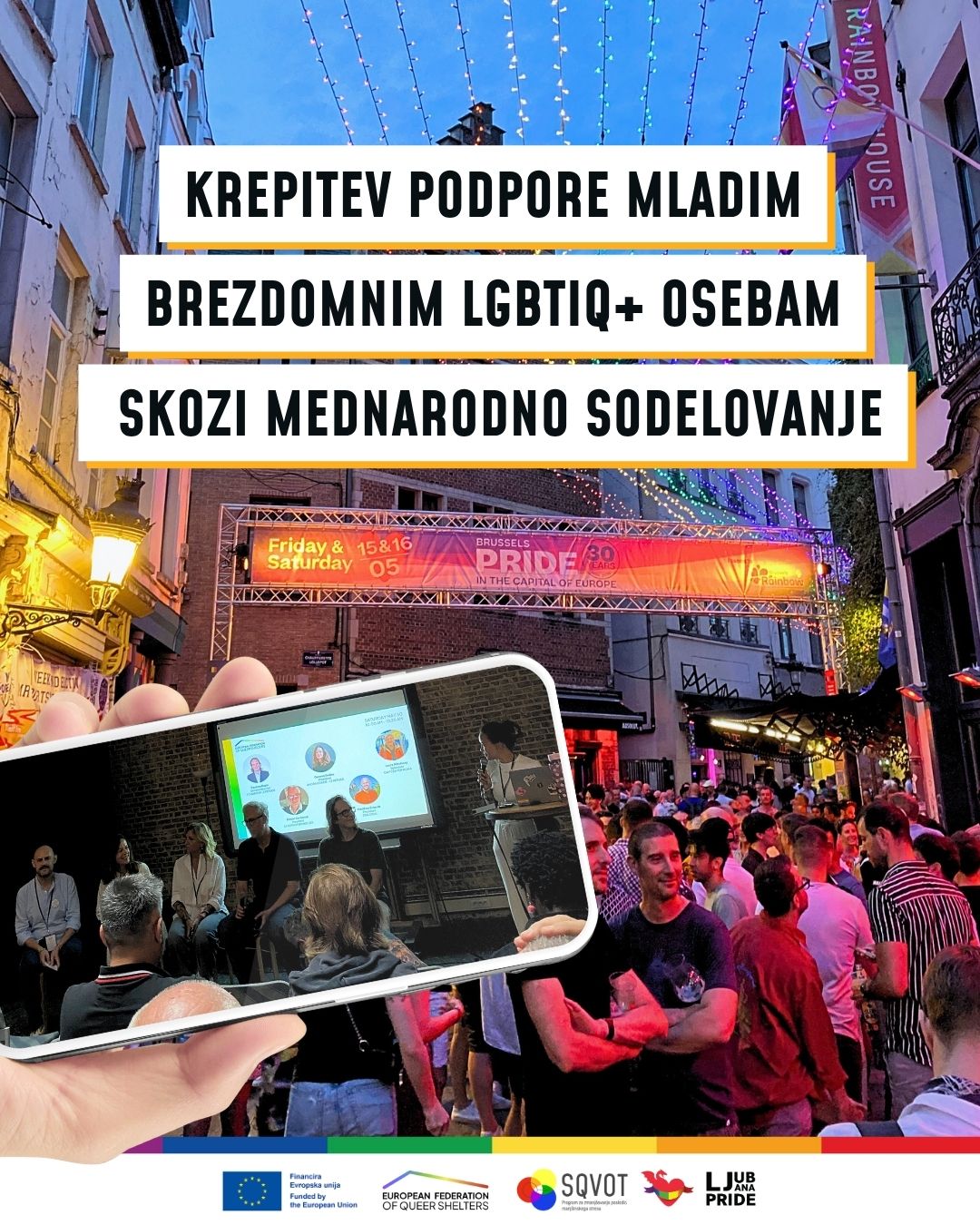
Between May 28th and June 1st, Anja, Simona and Shona went on a job shadowing trip to Brussels hosted by our partner organization Le Refuge LGBTQIA+ Opvanghuis.
As part of the program, we also attended the international conference of the European Federation of Queer Shelters, which aims to connect organizations that provide support and accommodation to young homeless LGBTIQ+ people.
We arrived in Brussels before the conference started on May 29th and joined a demonstration in front of the Senegalese Embassy, organized by our host organization. We stood together with around twenty other activists and supporters to express our opposition to the law passed in Senegal in March 2026, which increased the prison sentence for homosexuality from five to ten years and criminalized any so-called “promotion” of it. We find it hypocritical that our governments claim to protect LGBTIQ+ rights but at the same time are actively limiting the right to international protection for people who are persecuted in their home countries because of their sexual orientation and are also not being publicly critical of these countries when they adopt legislation that violates human rights, forcing people to flee. Therefore, it was inspiring to see how in Brussels an organization that primarily deals with support services for young people and social welfare work also takes a political stance and organizes protests like these.
The next day, we attended a reception at the impressive Brussels City Hall, where representatives of LGBTIQ+ organizations and institutional partners gathered for informal socializing and networking. We were addressed by the Mayor of Brussels – Phillipe Close, the CEO of Le Refuge and TÊTU – Pacôme Rupin, and the co-founder of Refuge Bruxelles – Dimitri Verdonck.
We opened the first day of the conference with an introduction of the five founding members of the European Federation of Queer Shelters. The representatives shared the story of the federation’s creation, its development, and the importance it has today in advocating for the rights of LGBTIQ+ people across Europe. The opening session laid the foundation for further discussions and the working sessions of the conference. At the same time, it reminded the participants that international cooperation, knowledge exchange, and joint action are key to effectively protecting queer youth and creating safer and more inclusive environments for LGBTIQ+ people.
Before lunch, we listened to a round table on Mental Health in Queer Youth: Challenges, Practices, and Pathways Forward, moderated by Pacôme Rupin. The discussion also included Simona Muršec, Rita Januário, Adam Bruton and Stephen Barris. It focused on the reality of the mental health of young LGBTIQ+ people, the specific challenges they face, and practices and strategies that can contribute to more effective support and better accessibility of services.
After lunch we attended various workshops on a broad range of topics. Shona participated in the workshop Beyond the Shelter: Rethinking Housing Responses for LGBTIQ+ Youth, where participants explored different models of organizing shelters and housing programs across Europe. Special attention was paid to comparing crisis and long-term forms of accommodation and the question of how to enable young LGBTIQ+ people to transition to sustainable and independent living solutions.
Simona attended the workshop Funding Queer Care: Power, Sustainability, and the Politics of Resources, dedicated to the challenges of sustainable financing of LGBTIQ+ organizations. Participants discussed different sources of funding, the importance of diverse income streams, and ways to strengthen financial resilience while maintaining the mission of organizations.
Anja attended the workshop titled Caring Without Burning Out: Emotional Labour and Sustainability in LGBTIQ+ Youth Support. Through examples from everyday work with beneficiaries, we explored ways to cope with burnout, the importance of setting personal boundaries, and strategies for maintaining one’s own well-being when working with vulnerable groups.
We concluded the day with a presentation of two pioneering initiatives that demonstrate how collaboration between LGBTIQ+ organizations, local communities, and funders can contribute to the development of new supportive spaces for vulnerable LGBTIQ+ young people. The projects show that by transforming existing buildings into spaces for housing, support, and community living, infrastructure can become an important tool for social inclusion.
On the last day of the conference, we, as part of the federation, dedicated ourselves to further structuring its operations and joined thematic working committees with other members. Committees were formed for the areas of asylum, advocacy and mental health, in which we defined key goals, strategies and ideas for future projects. During the collection of ideas, the need for a fourth working committee came up, namely ensuring adequate financial resources for the development and stability of the federation and its organizations.
We concluded the conference with a general assembly, which was particularly important for us, as Ljubljana Pride Association also formally joined the European Federation of Queer Shelters. Then another day awaited us – getting to know the infrastructure and work of our hosts at the local level in Brussels. We visited Le Refuge Brussels’s “Cadal” housing unit and reception center for LGBTIQ+ applicants for international protection, where we talked to the organizational team and social workers. They shared with us how their first housing units were created, how they cooperate with institutions and public donors to support their mission, and how they are currently cooperating with the Belgian federal asylum agency in providing safe accommodation for LGBTIQ+ applicants for international protection.
Overall, we’ve taken away many new insights, experiences and connections from our job shadowing in Brussels. These days gave us an insight into different practices of support and accommodation for LGBTIQ+ people across Europe, and an opportunity to exchange experiences with organizations that face similar challenges as us. It confirmed how important international networking and cooperation are in advocating for the rights of LGBTIQ+ people, especially at a time when our rights are being violated in many countries. Joining the European Federation of Queer Shelters opens up new opportunities for joint projects, exchanging good practices, and strengthening support networks. We returned home with new ideas, inspiration for further work, and a sense of being part of a broader European community that strives for a safer and more inclusive environment for all LGBTIQ+ people. We are already planning further activities in this area – perhaps we will be able to host one of the next conferences in Ljubljana.
The job shadowing activity is financed by Erasmus+, which is funded by the European Union.